
Elizabeth knelt upon her Faldstool. Archbishop Geoffrey Fisher prayed over her bowed head words had been spoken over the monarchs of the realm since the coronation of King Edgar in 973.
“O God, who providest for thy people by thy power, and rulest over them in love: Grant unto this thy servant Elizabeth, our Queen, the Spirit of wisdom and government, that being devoted unto thee with her whole heart, she may so wisely govern, that in her time the Church may be in safety, and Christian devotion may continue in peace; that so persevering in good works unto the end, she may by thy mercy come to thine everlasting kingdom; through Jesus Christ, thy Son, our Lord, who liveth and reigneth with thee in the unity of the Holy Ghost, one God for ever and ever . Amen.”
Now the fourteenth century song of the Introit arose, “Behold O God our Defender; and look upon the face of thine Anointed. For one day in thy courts is better than a thousand.”
Like any Communion Sunday, the service continued. The Epistle was read, the Gospel, the beautiful Nicene Creed was sung. That great and beautiful proclamation of faith filled the Abbey to the vaulted ceiling.
We may not remember the words spoken to us, even at so near-to-heaven a moment as our salvation or baptism, but Elizabeth remembers. She studied these passages over and over again before the day arrived, reviewing the historical and governmental aspects of it as well as the religious significance. While she practiced, in a very long corridor at the Palace, in a very long cape made of bed sheets, each step and turn of the choreography, the sitting and rising and that would take place, she was also learning all the finest points of the ceremony. In her makeshift robes, held by her Maids of Honor, up and down the palace floors, she prepared for the externals of a most internal transformation.
It is too bad, perhaps, that we are so little obliged to prepare ourselves for so magnificent a calling, too bad that no one has spoken the whole truth over us, and on a very regular basis. On the other hand, words like these ought to be memorable, ought to be remembered . . . we ourselves ought to treasure them:
“On that day you will realize that I am in my Father, and you are in me, and I am in you” (John 14:20, ) and
“You did not choose me, but I chose you and appointed you so that you might go and bear fruit—fruit that will last—and so that whatever you ask in my name the Father will give you” (John 15:16.)
Only once did Elizabeth hear the words the Archbishop spoke, a prayer that had survived nearly a thousand years, but she has lived by them for six decades. If no one speaks truth in our ears, we must recite it with our own lips. Our nearness to God is His delight, as well as our own. (Psalm 16:11) It is by remembering and believing what is true that we make our calling and election sure! (2 Peter 1:10)
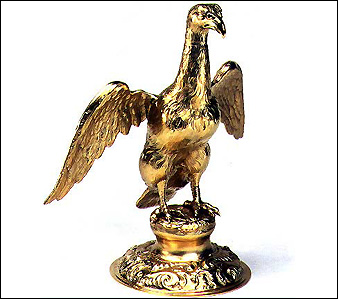
Now Archbishop Fisher brought the entire congregation to the sacramental moments of the ceremony, intoning the ancient Latin cry and hope, “Veni, Creator, Spiritus” . . . “Come, Holy Ghost . . . our souls inspire.” The moment of The Anointing was at hand, but without the Spirit of God, it was nothing. Elizabeth was about to smell the perfume of the special oils for the first and last time. She would wear it, one time. She would be closed in with God in sacred anointing unction, only once.
Words and fact of anointing have been spoken over us, if we will listen in the volume of the God-breathed text; we may earmark these words and read them again and again, daily, continually, until they conform our souls. What Elizabeth was about to experience is ours, and more: “As for you, the anointing you received from him remains in you … ” (1John 2:27.) Veni, Creator, Spiritus! Come . . . come!
The Ampula,
by permission


 Cor Unum Abbey