Westminster Abbey had been filling up since very early in the morning, at the soggy, dripping, chilly break of day. Some peers and peeresses, those who could attend with their coronets in hand, had brought sandwiches and sweeties hidden inside so that they might not miss “elevensies,” presumably. It was a sensible use for their headgear until the moment when the Archbishop would place St. Edward’s crown on the head of Britain’s fortieth monarch. By then, their snacks would have to be consumed so they could cover their bared heads with the emblems of their own rank.
Hours later, the Royal guests began making their way up the long aisle, finding their places, along with the designated representatives of nations. The Crown Prince of Norway came up the aisle, Prince George of Greece, General George Marshall of the United States and Georges Bidault of France, and His Royal Highness Prince Chula Chakrabongse of Thailand. There were sultans and ambassadors and prime ministers and queens in attendance.
In the Sanctuary, the Regalia were being delivered from the Jerusalem Chamber. These are the Coronation articles of royal and spiritual significance, from the Armill bracelets to St. Edward’s Crown; their names were “In the Program.” Had the guests all gone home, had the cameras and lights all failed, the Regalia had to be present.
The Princes and Princesses of the Blood Royal began their procession, followed by the arrival of the Queen Mother. She was beloved of the British and the Commonwealth nations. Ever at the side of her conscientious husband, together they had led the British people during the terrible war years. She was always brimful of courage and unfeigned compassion. She would arrive in those days on the scene of a bombed out building, stepping over rubble and seeking out the wounded and the grieving, the danger of a Blitzkrieg attack always present, and when the Palace was bombed, her response was, “now we can look the East End in the face.” In their sorrow and devastation, the people were relieved by their Majesties’ nearness. King George VI and his wife had done what they had been crowned to do, and they were loved for it.
This, now, was her daughter’s Coronation. Brian Barker, member of the Departmental Coronation Committee and Gold Staff Commander, wrote that he saw the Queen Mother pause for a moment, as her Mistress of the Robes gathered up her long train, to glance at the empty, ruby-red Throne beside which she had sat at her husband’s crowning and her own; no one alive knew better than she the duties and the dedication to which Elizabeth would be bound.
A long drum roll, majestic and momentous, reverberated against the marble walls, indicating that the Orders of Chivalry had begun their march, but spines had not yet been electrified as they were about to be. The Knights of the Realm continued their advance, and then . . . the earthly manufacture of heaven’s own instrument . . . the silver trumpets of the heralds, began to cry Her Majesty’s arrival. Everyone knew, with no mistaking, the young Queen was at the door.
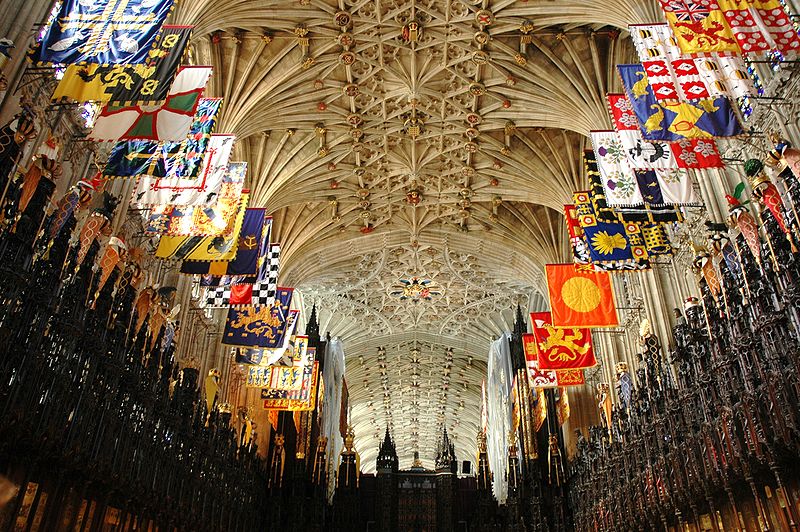
St. George’s Chapel, Windsor,
the heraldic banners
Josef Renalias


 Cor Unum Abbey