
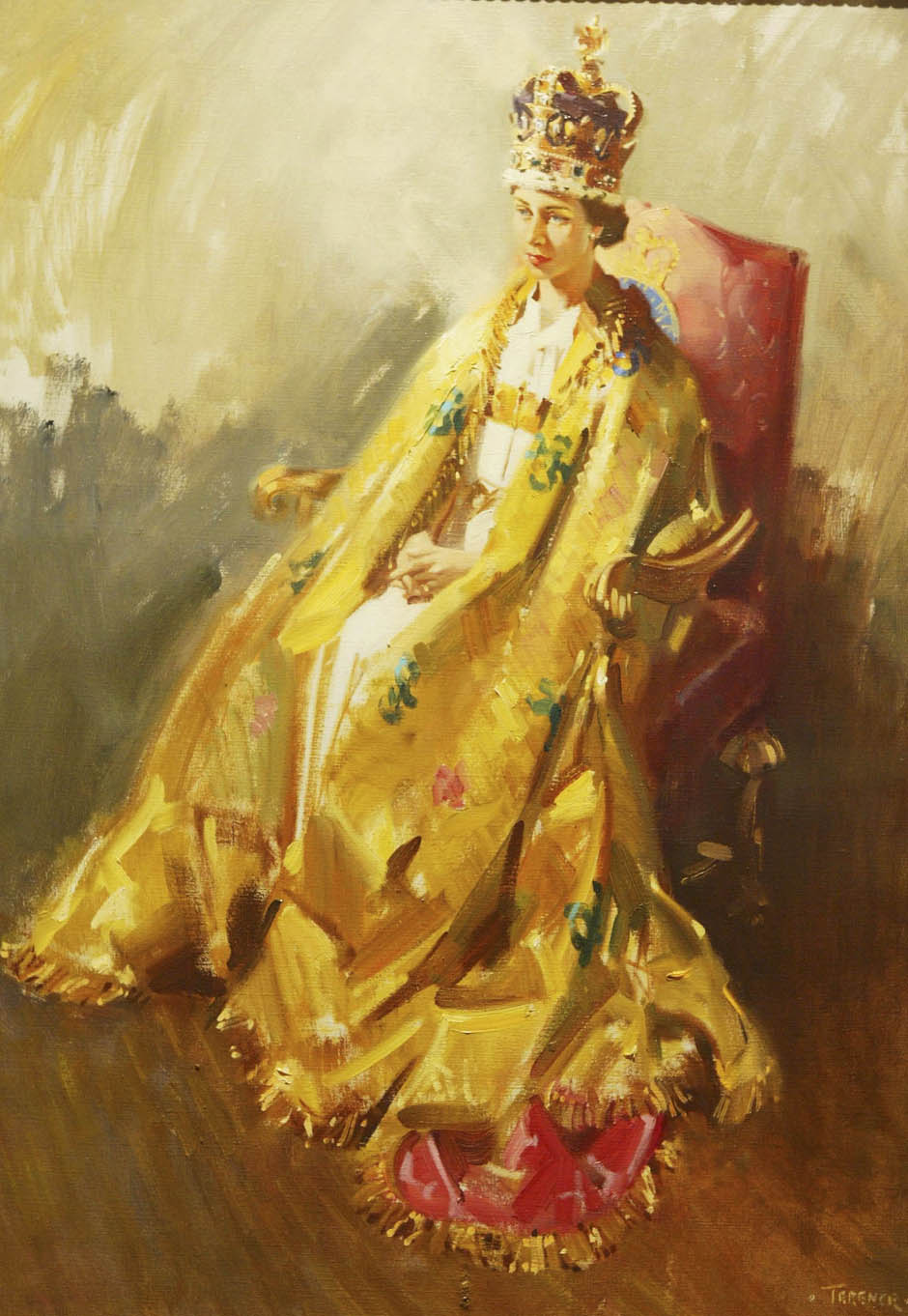
The bells in the north-west Abbey tower are pealing wildly, and ‘by signal given’ the mighty guns at the Tower begin to fire. The millions of souls on the streets are cheering “God Save the Queen! God Save the Queen.” Archbishop Fisher has lifted the ancient crown very high; it seemed suspended in air for a moment, and then . . . it rests where it belongs, on the head of the Sovereign of the Realm, the fortieth from William the Conqueror, but at least the 63rd from the very first rulers of the British Isles. She will never wear St. Edward’s Crown again, after this day.
When the tumult in the Abbey finally began to recede, the Archbishop spoke these words that had been spoken over those who had sat where she was sitting since 973 . . .
“God crown you with a crown of glory and righteousness, that having a right faith and manifold fruit of good works, you may obtain the crown of an everlasting kingdom by the gift of Him whose kingdom endureth forever.”
From the first entries in this little volume, we have been moving toward this day. We spoke of traveling through life, crowned with lovingkindness and compassion, as Elizabeth wore the George IV diadem to her Coronation. St. Edward’s crown, magnificent upon her royal head, is to us that other crown, the one which we are yet to wear.
Might not there have been a faithful little housewife, a humble coal miner or gardener or cobbler or bank treasurer who knew, as the moment came at last, that their moment would come some day, when they would have crowns of righteousness to lay at the feet of Jesus? Without doubt, such thoughts must have filled the hearts of many, those who knew their Bibles, who knew that a royal heritage was not Elizabeth’s alone.
As the cheering went on in the streets, one jubilant crescendo after another, the choir inside the Abbey took up a ten century-old anthem, the “Confortaré” of King Edgar’s day of enthronement.
“Be strong and of good courage,” they sang. “Keep the commandments of the Lord and walk in His ways.”
If ever she had been her own woman before, that life had come to an end for Elizabeth, but she willingly gave herself to the Recognition and the Anointing and the Investiture and the Crowning . . . not at all far removed our lives, rightly lived, for we are “bought with a price, and we are not our own. (1 Corinthians 6:19 and 20)
Now the Archbishop, in his full ecclesiastical splendor, pronounced the Benediction over Elizabeth and the Peoples of the Commonwealth during this reign.
An honor guard of peers of every degree was forming up the steps to the throne.
At earliest coronations, and according to the Liber Regalis, the Sovereign was to be enthroned at some height, where he would be visible to the people, and he was lifted, literally carried, to the throne.
Elizabeth rose from St. Edward’s chair, facing the congregation for the first time since the Recognition. She looked so small and so strong and so delicate and so determined. She mounted the five steps, and by simply reaching out to touch her as she turned (and to help her with the yards in length and pounds of weight of her robes,) they “set her” upon her throne.
“Stand firm and hold fast from henceforth the seat and state of royal and imperial dignity . . .” said the Archbishop.
“ ‘Watch, stand fast in the faith, be brave, be strong . . .’, and ‘Stand fast therefore in the liberty by which Christ has made us free . . .’, said the emissary of the Bishop and Guardian of our souls.
“Therefore, my beloved and longed-for brethren, my joy and my crown, so stand fast in the Lord, beloved.’” (1 Cor. 16:13, Galatians 5:1, Philippians 4:1)
Day after day we have seen that we have a rightful place . . . a necessary place . . . in the Kingdom of God, and thus in history. This is what Elizabeth saw and believed on behalf of her nation, and although our history is lived out on a very small stage, it is still recorded in heavenly annals.
We are lifted up to take our place at the right hand of God. (Colossians 3:1, 2) Should we fail to do so, families and churches and governments, and nations which are comprised of these, will fail. Our reign will be lost and the Kingdom of God will not prosper in our sovereign care, for caring is sovereign, as Elizabeth knows so well. These thirty-two days together are about the majesty of caring enough to make sure we live according to the royal law of love. This will require diligence, effort, perseverance, planning, the willingness to be misunderstood, and sacrifice.
The Queen went out from Westminster Abbey to return to work the next morning, a grueling schedule, an unbending regime, a heavy burden of responsibility. All the Regalia and all the Vestments were returned at close of day to the Tower of London, and the Queen returned to her desk, her “boxes,” delivered twice daily, every day, of official correspondence, her meetings and briefings and public appearances.
We have seen Her Majesty, seated in splendor upon her Throne, but when the new day dawned, she was, as before, one of the hardest-working women on earth, now consecrated to every effort, every difficulty and decision, and yes, sacrifice. She has made a point of making others feel that their work and service matters supremely. Her life tells us: if we will do what we have been given to do with all our hearts, persevering in all trial and all affliction, if we will continue in peace and goodwill, trusting in God and doing what is right, we will not fail of the majesty of our calling.
She has not failed. She has triumphed, and so shall we, for Christ is our life, and His love never fails. We are crowned and robed with it, vested with faith and hope, possessing the Sword of the Spirit, which is the Word of God, and wearing the Lord’s signet … “I am my Beloved’s, and He is mine” (Ephesians 6:17 and Song of Solomon 6:3)
This remains … we may take the seat of sovereign care, where we will bear the burdens of others and so fulfill the law of Christ (Galatians 6:2,) casting our own care upon Him Who cares for us (1Peter 5:6, 7.) This is majesty . . . this is the wearing of the royal robes and the possession of the almighty scepter. (Psalm 125:3) This is the day-to-day measure of a life that will one day be crowned on high. (Revelation 2:10)
Tomorrow and the next day, we will see the last and vital parts of this ceremony. Today, we are crowned in beauty, robed in splendor . . . even if all that others see is that we took time with them, that we maintained a happy hope, and that we found our joy in the life we live in our Savior, the Humble King of Kings and Lord of All.
Portrait by,
Sir Terence Cuneo, 1953


 Cor Unum Abbey