
“In the case of a will, it is necessary to prove the death of the one who made it, because a will is in force only when somebody has died; it never takes effect while the one who made it is living. (Hebrews 9:16, 17, NIV)
Elizabeth and Phillip were in Kenya when her father died. He had been recovering from surgery and illness, but had seemed to be regaining his strength. Somewhere in the night, probably in the earliest hours of February 6, he took his last breath. Far from home, unbeknownst to her or anyone else, Elizabeth’s next breath was that of a Monarch.
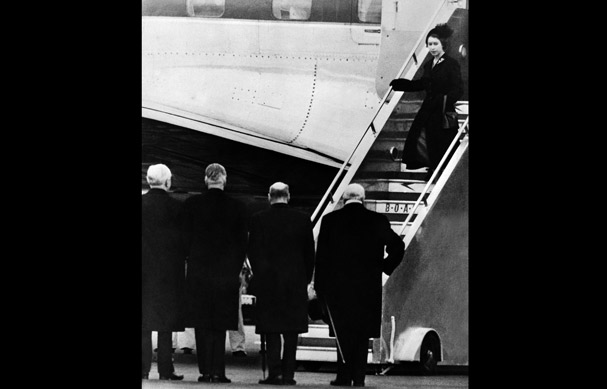
She flew home immediately, cutting short the tour she and Phillip had undertaken in his place. That night the Accession Council met in London, setting in motion the events that would proclaim her reign throughout her kingdom, lands, and dominions all over the world, but Elizabeth was only then on her way to catch a jungle plane that would take her to the next stage of her sorrowful journey home. She traveled all night and long into the next day, and at last, on February 7, she came down the steps of her BOAC aircraft to her waiting privy counselors, all dressed in black, and as she did, they bowed their heads. She, too, wore mourning clothes that had been included in her luggage, a part of the never-failing preparedness of those who serve the royal family.
“This is a very tragic homecoming,” Elizabeth said to Winston Churchill, who stood at the head of the line of her counselors, and indeed it was. The love she had for her father, indeed for all her family, was deep and true. She belonged to an immensely happy family, full of mutual love and comforts and understanding. She entered into her reign, not exulting in privilege or power, but in grief and duty.
No more would she be free to follow Phillip to Malta and live as normal a life as she had ever known as a Navy Lieutenant’s wife. No more was she The Princess Elizabeth, charming and delightful and relatively safe from censure and failure. No more would she be able to work alongside her beloved father, which had been her joy. Now she would have to stand, alone in his place. Now it was her own place, for good or ill.
It is lonely at the top, and rightly viewed, this is true at the pinnacle of every life, where no one can choose for us or do for us what must be done. There we are in solitude with the Lord. His death marked our accession, from darkness to light, from lost to found, and from shameful to sacred. The Scripture says that once we were not a people, now we are God’s own. Once we were without mercy, and now we have received mercy. Now we are a royal priesthood. (1 Peter 2:10) No earthly ceremony can accomplish such a consecration, but we who live by faith have acceded to great honor and responsibility.
Elizabeth’s Coronation Day certainly highlighted the splendors and the obligations of God’s choosing. A very long and complicated strand of accessions had brought her to this hour. She had become heir to the throne of a powerful kingdom, centuries old. As we have seen, she was Queen because one of those strands, the rightful successor to the throne, abdicated his place in history and in the hearts of his peoples. May it never be that we should refuse the duties of “reigning.” There are charges upon us, according to our inheritance: kindness and generosity, prayer and service, worship and obedience, repentance and honesty, and more besides, but we, in Christ, are fit for the task. We might have to leave some other loves behind, but at tremendous cost do we trade this kingdom for any other infatuation.
“We love, because He first loved us.”
(1 John 4:19)
Elizabeth II returns to Great Britain
public domain


 Cor Unum Abbey