
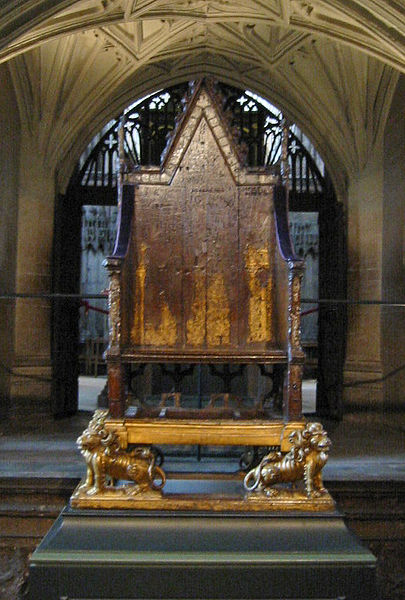
King Edward’s Chair would “Inthrone” the Queen before the ceremony was over, but by consent and recognition, she was privileged to sit upon it. Remember that something extraordinary was about to happen? Queen Elizabeth was about to bow, and on this occasion, not before God alone. She awaited the Recognition and Consent of the Church and of the Peers of the land.
“Sirs, I here present unto you Queen Elizabeth, your undoubted Queen, wherefore all you who are come this day to do your homage and service. Are you willing to do the same?” With a breath, the answer broke forth, “God Save Queen Elizabeth!”, and Elizabeth II bowed to the will of her peoples.
To the south, west, and north sides of the Cathedral, the same question and the same answer, and each time she bowed a small, regal acknowledgement that she was their Queen. She would never bow before them again, nor to anyone else.
Elizabeth was Queen by the Consent of her government and thus her peoples, and by the peers, the members of the five degrees of nobility, who saluted Her Majesty with their blessing. These were not invited to the Coronation – they were summoned! They were required to attend to give their support and their blessing … “God Save the Queen!” She acquiesced to a place so high that she would bow only before God from that day forward.
Much is made at times, between churches and nations, over the issues of bowing, but much more to the point for us is this: is our “majesty” recognized? Elizabeth has humbled herself to the role her government gives her, to a love for people from all walks of life, to her royal inheritance, and to the service of the nations and lands that acknowledge her as their Monarch. That is a template we could use in our own lives, governed as we must be by the Word and the Spirit of God.
Archbishop Fisher taught that when a believing monarch is crowned on the earth, he or she is meant to exemplify the royalty of life in Christ, within a recognized sphere of influence. In that regard, “we” have everything in common with “them.” Those who reign over nations in the Name of the Lord are doing what each of us must do: having dominion only as far, but fully as far, as it is given in the scope of an individual and personal vocations. Their influence is, in fact, greatly limited and curtailed by rule of law; ours is much more sovereign, within our homes and often on the job.
We do not have a good relationship with this terminology! Reigning! Dominion! Sovereignty! – what words shall we use to indicate that there are some things in life that depend upon a little healthy oversight and authority? Let’s beware that, not using the words, we do not fail to take up the fullness of our responsibilities.
“Sovereignty” is all around us, and for the most part we want it and respect it. We have little use for the police officer who would direct traffic in a busy intersection with placating suggestions. When it’s our turn to move, we want to know he has all other traffic at a standstill! At the wedding altar again, both parties want to trust that the other has “dominion” over their own decisions, to keep the vows they are making!
The truly successful man or woman, the one who reigns so well that everyone succeeds when they follow his or her lead, is valuable and rare. What’s more, neither is apt to say to their son,
“Hey, will you sit down in the buggy, please? I want you to sit down, now, okay? Come on, I already told you twice! Why won’t you sit down for Daddy/Mommy? There you go … don’t make me mad, now … thanks, Buddy!”
Oh it is a wonderful thing to consent to be “bossed,” to learn to obey, to recognize God-given, God-ordained authority and to go and do as one has been told by the one who is in charge! It is a wonderful thing, too, to take up the mantle of the authority we’ve been given, to hang up our towels, put the lid on the toothpaste, bring our trash cans in at night, to bring up happy and obedient children, and give a day’s work for a day’s pay. It makes God look good when we use the authority we have been given to break a bad habit. Many are the areas where we must recognize the work of the Holy Spirit in our lives and consent to be conformed to the imagine of Jesus Christ.
The Roman centurion knew what it was to have authority and to be under authority, and his understanding gained for him not only the healing of a much-loved servant, but also some of the highest praise Jesus ever spoke.
Call it what we will, our lives have an inherent majesty when we humbly accept the authority that is ours. The neglect of sovereignty can be as devastating as its misuse, as history makes plain. Nearly all in a group of adults around the table will be able to tell the story of a no-nonsense parent or coach or teacher or grandparent who demanded respect and bequeathed a healthy portion of self-respect, someone who “bossed” us, made sure we did as we were told, and brought out the best in us. We gave our consent, and years later we recognize them as having had great influence for good in our lives.
May God grant that we become willing and faithful in the little things, in all the things, that belong to our own sovereignty. May we be dedicated keepers of the faith, and of the vineyard where we are called to labor, in authority and under authority, recognized for our rule over our tongues and habits, a people to Whom God’s consent has been given that we may become the Sons of God. (John 1:12)
St. Edward’s Chair, by permission


 Cor Unum Abbey