Cor Unum Abbey

Marketplace Monasticism … How to Live in a Downtown Abbey

  • About
  • July 9 – Sacred Simplicity

January 5 – “Passio Christi, Conforta Me!”

Posted by Cor Unum Abbey on January 5, 2014
Posted in: devotional material, personal monasticism, Spiritual disciplines, Uncategorized. Tagged: comfort, loneliness, the God of All Comfort, widowhood, women alone. Leave a comment

Image.

Our precious and sometimes costly time together is going to allow a more defining focus for loneliness this year.  Once again, welcome, welcome with open arms to all of those who are seeking the Presence of the Lord, but to those who have suffered a little loneliness, or a dark, crushing, debilitating loneliness in the last seasons of life, welcome with this assurance: loneliness can gain for you what even the greatest security of human love cannot.  (Matthew 6:6, 1 Timothy 5:6, Psalm 34:6))

We have heard these words before in Cor Unum, “Passio Christi, conforta me!”  These are the first syllables uttered by novices in traditional Carmelite houses, and perhaps other houses of religion as well.  As they cross the threshold of the monastery, these trembling women are warmly greeted by Sister nuns who hear their first prayer, “Passion of Christ, comfort me!”

It may be true for some of us that loneliness will keep us regular company.  All of us can choose a little less social life when necessary, a little less shopping, less keeping up with the most recent movies, the news, all the books we love best in order to spend a bit more time in prayer and worship, a bit more of life being made willing to feel and think and hear and resolve.  This year, Cor Unum is extending its heart to those whose hearts are left alone in this world, whose souls will never again hear words of love from a spouse or parent or child, or see the face held most dear.  Millions and millions of women will not feel tonight the touch of a hand that once reached out in the dark to intertwine fingers; not even a “Good night” will be heard, ever again.

Millions and millions of women live in the knowledge that the love that transported their lives is gone and will never return.  Should that be you, enter.  Come in and live with us a life of learning the touch of God upon your heart, the Voice that always says, “Fear not, I will help you.”  (Isaiah 41:10)  We must, we absolutely must, learn to hear and feel the love of God.  If we do not, we will spend the rest of our lives trying to get from others what He alone can give.  Some might remarry, but for all, human love will never suffice.  Married, we must live in the love of God that we may love another.  Widowed, single, alone, we must live in the love of God that we will never need another.

“Passio Christi, conforta me!”  Oh, those Sisters know what they are about!  They know how comfortless is the cloistered life until the God of All Comfort prevails over loneliness, deprivation, sacrifice, and loss.  Married or single, widowed or divorced, there is a comfort that comes from God, that He brings with Him, that will not be denied us.

Glorious day!  From the rising of the sun to the going down of the same, the Name of the Lord is to be praised!  What will it be like to fall asleep, never again alone, never forsaken, never forgotten, joy for a pillow and hope a canopy over us.  We will all find out, and the blessing of peace will not pass us by.  We will sleep with the One who keeps our heartbeat in the night

Isaiah 41:10 … So do not fear, for I am with you; do not be dismayed, for I am your God. I will strengthen you and help you; I will uphold you with my righteous right hand.  (NIV)

Matthew 6:6 … But when you pray, go into your room, close the door and pray to your Father, who is unseen. Then your Father, who sees what is done in secret, will reward you. (NIV)

Psalm 34:6 … In my desperation I prayed, and the LORD listened; he saved me from all my troubles. (NIV)

1 Timothy 5:6 … The real widow, left all alone, has put her hope in God … (HCSB)

Family photo, Cor Unum Abbey

January 4 – Is There a Balm in Gilead?

Posted by Cor Unum Abbey on January 4, 2014
Posted in: Uncategorized. Tagged: faith, purpose, the Balm of Gilead, widowhood, women divorced. Leave a comment

Image


There is a built-in cloister for some lives.  There are those, it would seem, who were never meant to marry, and certainly there are many whose marriages have failed, who have been left alone.  For others, death brings thirty, forty, fifty or more years of married life to and end and the two that were made one now live, one approaching our hereafter, and the other inside it.

A friend of Cor Unum Abbey comes to mind.  She lost her husband, not through death but through an awful adulterous affair.  She wanted her marriage more almost than life itself, and living was very difficult for her for a long time after her husband’s betrayal and abandonment.  There was no balm in Gilead for her, except the Balm of Gilead.  (Jeremiah 8:22)  We are going to become very familiar with the comforts, the healing, and all the restorative powers of this Anointed One, this Christ.

There is always Jesus, our Lord, and the Monastery of our Hearts will always be His home.  When we cannot have what we feel we cannot live without, we may always obtain the fulness of life in Him.  (John 10:10)  This is certainly true for married men and women as well, and this truth would have saved countless marriages.

We are stepping over the threshold of life within the veil, of life lived where Jesus is, never leaving Him who will never leave us.  We know we do leave Him sometimes, momentarily, but we turn, our gaze seeks Him out, and there He is, near, with only the most holy jealousy between us.  We repent that we wanted a little independence from His Presence, and we return to His love.  We aren’t good at it, but we will be.  Oh, we will be so much better at finding Him in His Word, at hearing the Voice of His Spirit, at walking in truth and peace!  Postulants practice holiness, and so shall we.  It won’t be holiness for show but for the glow of living in the abundance of the love and the obedience of Christ.


Jeremiah 8:22 … Is there no balm in Gilead; is there no physician there? why then is not the health of the daughter of my people recovered? (NIV)

John 10:10 … The thief comes only to steal and kill and destroy; I came that they may have life, and have it abundantly. (NASB)


Valentine of Milan, Mourning Her Husband, the Duke of Orleans

Fleury-Francois Richard, by permission, public domain

January 3 – One Vow

Posted by Cor Unum Abbey on January 3, 2014
Posted in: Uncategorized. Tagged: devotional life, knowing God, monasticism, Psalm 27:8. Leave a comment

Image


We love this woman.  She is a Chinese nun and we don’t know whether hers is a Buddhist or Christian faith, but she speaks to our hearts.  She chose devotion.  Alone, on her way back to her convent, no car, no escort, no frills!  What does she seek, we wonder?  With glad hearts we rejoice today to know Whom we seek, and we give thanks that such knowledge is privileged and it is very high and it is not of our own divining.  Neither is is exclusive, a secret to be hoarded, or a lifestyle to set us apart without the responsibility to make welcome all we meet.

If we met this monastic, perhaps we could share with her the living faith that is ours, and perhaps she would rejoice to meet “Sisters” in the faith.  Certainly, she could teach us a great deal about a life closed in with God.  For her and for us, if we know the Son, we know the Father.  (John 14:7)

Sometimes we need to take a look at what we are NOT doing here.  We aren’t after solitude for its own sake, even though in our busy, noisy, intrusive world, a little path like hers intrigues us.  We aren’t seeking religious experience, and we certainly aren’t trying to make God like us better.  There is no doubt that one of the most precious, certainly the most priceless, aspects of life in Christ is that we know God is not going to love us any more or less than He did when He gave His Son to die for the world He so loves.  (John 3:16)  We are trying not to try to obtain more love than that, because it would be a big waste of time.  We can, however, fellowship with Him more and better, and that fellowship can grow until we become  an “aroma” of Christ in the earth.  (2 Corinthians 2:14 and 15)

Our devotion here in Cor Unum, there where you are and here in this shared monastery, is to the fulness of Christ, to learn to do all that we do for His sake, to know and enjoy Him more and to seek Him ever faithfully.  We don’t strive to be loved better, but better to love the Father in and through His Son.  Better to love this woman and all those that share our path.  We know that we can listen more carefully to His Spirit than we often do as He speaks to us (Hebrews 3:7,) His Word can dwell in us more richly than it does (Colossians 3:16,) and we can give Him thanks and worship Him even more faithfully day by day (Philippians 3:3,) and not just a checklist “more,” but the priceless “in all things” more.

All this will take a little forethought and decision, and it will require time and steadfastness.  Something will probably have to give way, but beyond doubt, if we haven’t time for God, something needs to be dislodged.  Three hundred sixty-two more days in this year, alone.  We can do it!

What vows did this woman make in order to enter the convent at the top of the stair?  We don’t know, but this is the only vow we will ever have to make …

When thou saidst, Seek ye my face; my heart said unto thee, Thy face, Lord, will I seek. (Psalm 27:8, KJV)


John 14:7 … If you had known Me, you would have known My Father also; from now on you know Him, and have seen Him.”  (NASB)

Hebrews 3:7, 8 …  Therefore, just as the Holy Spirit says,

“Today if you hear His voice,

 Do not harden your hearts …”  (NASB)

Colossians 3:16 … Let the word of Christ richly dwell within you, with all wisdom teaching and admonishing one another with psalms and hymns and spiritual songs, singing with thankfulness in your hearts to God.

Philippians 3:3 … For it is we who are the circumcision, we who serve God by his Spirit, who boast in Christ Jesus,and who put no confidence in the flesh.

 photo used by permission

January 2 – Three and a Half Years of Undiluted Jesus

Posted by Cor Unum Abbey on January 2, 2014
Posted in: Uncategorized. Tagged: Bible reading, faith, the Gospels, Walking with God. Leave a comment

Image


For today we are taking a moment to remember that Jesus told us how to find the “work of God.”  It is, He said, “to believe on the One whom He has sent.”  (John 6:29)  That is our vocation, and it is a worthy one indeed!  As we live out our lives in the Abbey of our souls, we will discover simple, happy, effective ways of laying aside every sin and weight that would keep us from running this divine race, the goal of which is CHRIST!

Here in Cor Unum, we believe that God can be known, that He wants to be known, and that the knowledge of God will ever be our strength and our fulfillment in life, wherever life leads us.  God leads us, in life, into His Son, our Lord.

Inside these walls, you won’t miss the will of God, even while you hold down a demanding job, fulfill civic obligations, drive children to sports and practices, fold clothes, wash dishes, love your husband, or, as many women have found even more difficult, as you face another day alone and without even the anchor of work and obligation.  Postulants and novices are we all; tomorrow, we will take a look at the one and only vow that obligates us to try this holy vocation.

Toward that end, we are beginning the New Year with a project.  It was introduced first to a young man in prison by a minister who visited there.  He challenged the inmates who came to hear him speak to get hold of a Bible and read through the Gospels five times.   That’s all.  One of them, at least, took him up on it.  The minister had told them that, on his own third reading of the life and the very words of Jesus Christ, his life had been changed forever.  The inmate, a very young man with quite a long sentence, who had been raised in the church, said that on the third reading, his life, too, underwent a change so dramatic that today he is the pastor of a thriving church “on the outside.”  He’s still young, but he speaks powerfully of the Person of God.

It is that Person Whom we seek.  In the Song of Solomon, the Shunnamite could not rest until she found the one her soul loved, (3:4.)  There is a pursuit, and there is a discovery and a very great reward.  We all hope that during the year ahead, inside these cyber walls, that we will find Him, and toward that end, we set ourselves to settle for nothing less.  We will remember and we will determine that nothing less, no amount of involvement and no degree of happy feeling will take the place of True God.  Having found Him, we will have true love for others, true peace, the kind that passes understanding, and true hope, which never disappoints.  (Romans 5:5)

Even so, with benefits marvelous and eternal, it is Jesus we seek, Jesus for His own sake, Jesus Himself.  If that is the desire of your heart, or the desire you want to see rule in your heart, you have come to the right cloister.  Five times through His life of earth, hearing every recorded word that He spoke, seeking Him, looking for Him, hearing His voice … author and pastor, Francis Frangipane says that the only difference between the us and the disciples was that they had three and a half years of undiluted Jesus.  We here in Cor Unum will find a way, many ways, and all by His own provision, to come just as close.

After all, we have His Spirit, and that is close indeed.
Red-Headed Woman in the Garden of M. Foret

Toulouse Lautrec, public domain and by permission Continue Reading

January 1 – Alone in the Abbey

Posted by Cor Unum Abbey on January 1, 2014
Posted in: Uncategorized. Tagged: Jeremiah 29 12-14, monastic life, prayer, purpose, women alone, worship. Leave a comment

Image

The New Year comes quietly in the Abbey.  The rolling over of a new day isn’t permitted to take too much upon itself.  For us, assessments are made day in and day out, and a new page is turned whenever the old becomes brittle, selfish, or self-satisfied.  Change is never far from us.  The making of resolutions is nothing new to us.  The keeping of them keeps us within these walls, invisible though they are.

Even so, the first day of a New Year is an event, a milestone, and particularly for Cor Unum Abbey.  We were founded on New Year’s Eve, with these words . . .

Every evening, in Bethlehem, Connecticut, forty Benedictine nuns settle into the Grand Silence that follows Compline, the last Office of the day. All speech is curtailed but for prayer and praise during Matins at 1:50 a.m., and the profound monastic silence continues until well after daybreak . . . 

With those words we began a monastic adventure that all of us could travel at home and on the job.  Men and women, married, single, divorced, widowed, all endeavoring to find that place of stillness, that heart’s monastery, where every believer in Christ Jesus may dwell with Him in the fulness of His resurrection.  We set out upon a quest within the cloister of our devotional lives, with the hope of learning to abide in Him as we are meant to do.  Ours is a cyber monastery, and we learn from and help one another.

All over the world, even in countries that don’t promote or even allow the spread of the Gospel, monastics have managed to find one another and to find purpose in prayer, solitude, and devotion.  For several years now, we in Cor Unum Abbey have been taking our place among them without leaving home.  We are real nuns here in this Abbey, because real monastics are those whose vocation is to find God and to dwell Him toward the working out of their salvation with fear and trembling.  Of course we must stay married, raise our children, keep our jobs, continue in the paths that are ours to travel, but we will not miss out on the glories – and the discipline – of cloistered life.  All live alone before God in the recesses of the soul.  While most of us will not have the volume of time or singleness of focus that draws traditional monks and nuns into the “religious life,” ours are true monastic hearts.  We, as hundreds of thousands before us, are marketplace monastics; we can only give what we have to give, so we give it.

As lovely as it would be to be able to devote seven intervals or more to prayer and worship and stillness, day in and day out,  as do traditional nuns in cloister, we have learned to make the most of even seven minutes to call our own. For us, a life too full of everything but devotion is an empty life, or at least a life with a dangerous black hole.  Our persuasions and predilections, our selfishnesses, lazinesses, and even our fears will fight against the fellowship and the friendship we have with God.   Cloistered nuns would be quick to tell us that the same held true for them, sometimes for many years inside doors closed and bolted against the world.  Here in Cor Unum, and like them, we keep wanting a divine friendship anyway, with that purity and simplicity of devotion to Christ that we know can be lived out at our address, somehow, with starts and stops.

Here in Cor Unum we come from lots of different backgrounds, churches, and inspirations.  We are cloistered in houses and apartment buildings and dorm rooms.  Many of us are quite alone; others have husbands and children, jobs and civic obligations.  What we share is a determined search for the Nearness of God in the happy faith that if we seek Him, we will find Him. (Jeremiah 29:12-14)  We aren’t playing at monasticism, not at all.  We have discovered this truth, that no one can live out our lives in Christ for us.  No one can make us worship or pray, no one can hope or love or trust in our place, but then, no one can take any of that from us, either.  To each is given a place in Christ, and that is our monastery, our cloister.  Jesus promised, “I will come to you,” and He is true.  We make of our hearts an Abbey where He is pleased to dwell and where, by His own word, He will abide with us.

We welcome you.  As the days go by, we will see with increasing certainty and joy that the human heart is the monastery where those who love the Lord may fellowship with Him, where He will come and stay, never leaving, never forsaking us.  Married or single, whatever your age, the nuns of Cor Unum Abbey welcome you.  Although we may live thousands of miles apart, what we share is vital and valid.  Whether life for you seems frantic and beyond any hope of order or stillness, or if your life has become so quiet and lonely that you wonder why you’re still living it, there is a habit for you here, a holy habit of worship, of joy and fulness and of the peaceful, powerful obedience of Christ.  (1 Peter 1:2)

Jeremiah 29:14 … And I will be found of you, saith the Lord: and I will turn away your captivity, and I will gather you from all the nations, and from all the places whither I have driven you, saith the Lord; and I will bring you again into the place whence I caused you to be carried away captive.  (KJV)

1 Peter 1:2 … Elect according to the foreknowledge of God the Father, through sanctification of the Spirit, unto obedience and sprinkling of the blood of Jesus Christ: Grace unto you, and peace, be multiplied. (KJV)

Entrance to the Community of All Hallows Convent

Evelyn Simak, by permission

Day Thirty-Two – Royal Rejoicing

Posted by Cor Unum Abbey on June 5, 2013
Posted in: Uncategorized. Leave a comment

Image

Now, and for the first time during a Coronation service, as the organ lifted up the melody to the “Old Hundredth” (Psalm 100) the voices of all those in attendance began to sing along,

All people that on earth do dwell,

Sing to the Lord with cheerful voice.

Him serve with fear, His praise forth tell;

Come ye before Him and rejoice!


         Rejoice they did, as Elizabeth made her way with the Bishops to the Altar.  She relinquished the Sceptres and her new Crown, and presented an ancient oblation of one altar cloth and a wedge of gold.

The new Duke of Edinburgh joined her there.  Elizabeth and Philip were taking communion together at the altar of her crowning.

As they knelt in prayer, the atmosphere changed once more in the Abbey.  The cameras were turned off during their sacrament.  The glory and splendor of the Coronation bowed deeply before the glory and splendor of this Communion, and Philip and Elizabeth were alone with God.

Then the Queen took up her crown again, and she was the only Monarch in modern times to wear it during the entire service, following the Communion.  All those rare and precious gems made it very, very heavy.  She returned, crowned and with her Scepters, to her Throne.  The service oontinued; it might have been any Sunday morning, and then the Archbishop spoke the words of blessing and dismissal.  The “Gloria” was sung, and the beautiful “Te Deum,” and then the trumpet fanfare began afresh … trumpets, organ, choir and orchestra … all rejoicing!

Now the swords began to move beside her, and born again by her ministers, with the Archbishop leading the way, and Elizabeth rose and passed out of the Theater and into the sanctuary of St. Edward’s Chapel.  There, at last, she exchanged his crown for the lighter, but no less brilliant and imposing Imperial Crown.  She would never wear St. Edward’s Crown again, but no need!  She was Queen, she is Queen, she is crowned, she is Majesty.  She was divested of all her ceremonial robes and was adorned for the first time with the luxuriant Robe of Purple Velvet with its six-foot train, made just for her and embroidered richly in gold with her own “EIIR” insignia and all the beautiful and symbolic needlework that had taken so many months to complete.  She alone would ever wear it.  Before it was completed by the master embroiderers at at Ede and Ravenscroft, every employee in the firm, down to the charwomen, had been invited to put in a single stitch, a tiny thread overlaid with gold.

In her right hand the Queen bore the Sceptre with the Cross, and in her left, the Orb.    Her Coronation gown was visible again, and as she traversed the length of the Abbey, surrounded by columns of honor, she sparkled like a thousand stars.  Even on the black and white film, not yet governed by every degree of precise high definition, her gown and jewels and crown and Sceptre glittered and danced with the play of light.

As she reached her carriage a shout arose as if it would crack the mortar between the Abbey’s ancient stones . . .

A new Elizabethan era had begun, and the rejoicing was tumultuous, deafening, along the route back to the Palace.  It was raining again, but her happy subjects would not be denied.

How riotous was the joy in heaven as we were received into the Kingdom of God, to reign and rule with His Majesty, King of Kings and Lord of Lords, Jesus of Nazareth, Only Begotten of God Almighty?  Angels, mighty and splendid, rejoiced for us and for the joy of their Sovereign, who wanted us so much.  We were the object of His love and desire unto death by crucifixion.  Imagine the ecstatic jubilation of those who revere and worship Him, those that have been faithful to Him in heaven and on earth.

Our time together has come to an end.  There was so much more . . . from the Coronation Chicken, a curried specialty by Constance Spry, the recipe for which hit women’s magazines all over the world.  There was the admonition that had gone out to all royal and government servants, that they would “abstain” for forty-eight hours before the event, and not from alcohol alone!  We smile, but it lets us know, this was for them all a most holy day.  And there was Winstone Churchill, her Prime Minister, lingering awhile as others found their places for the recessional, looking about him, taking it in, alive in the history of his nation.

The Regalia was ready to be packed with great care, under guard, and returned to the Tower of London.  St. Edward’s Crown would remain there until Elizabeth’s funeral, when it will adorn her casket.  Then, after months of planning and preparation, the next royal head will wear it on just such a day.

As Elizabeth had been given a few moments in St. Edward’s chapel before her recessional and the return to Buckingham Palace, we have just a few last moments together.  The celebration was just getting underway in London, and it would go on until late into the night, with fireworks and a last appearance on the balcony to mark the close of this magnificent event.  Her Majesty would awaken the next morning, the Monarch of her realms, under oath, anointed, and empowered to serve and defend her peoples as long as she lived – in short, to be their Queen.

We may awaken tomorrow to live a royal life, if our understanding is true!  In fact, if our understanding is true, we must.  While she will never again wear St. Edward’s crown, we may take our diadems, the kindness and compassion of the Lord, from our bedside and put them on, never leaving our chamber without them!  We may know that heavenly crowns await us, crowns that we will cast at the feet of our Sovereign.  There will be splendors seen by those with eyes to see, deeds of mercy and costly sacrificial gifts of loving kindness and compassion and faith.  Her Majesty will never again wear the Colobium Sidonis or the Supertunica or the Imperial Mantle, but we will be filled with joy, abiding in hope, clothed in the beauty of holiness. She, too, as she reigns in the grace and mercy of God.  Majesty will be seen in us, and others will know it is a majesty bequeathed, not usurped, humble and grateful, not haughty or selfish or rude.  All this in tedium, in trial, in difficulty, in small victories and large challenges, just as the Queen has known, but all the while, we will bear a glory, for as it is written,

 “Those who are wise will shine like the brightness of the heavens, and those who lead many to righteousness, like the stars for ever and ever.  (Daniel 12:3)

Those who look to him are radiant; their faces are never covered with shame.”   (Psalm 34:5)

But you are A CHOSEN RACE, A royal PRIESTHOOD, A HOLY NATION, A PEOPLE FOR God’s OWN POSSESSION, so that you may proclaim the excellencies of Him who has called you out of darkness into His marvelous light; (1 Peter 2:9, NASB)

The LORD their God will save them on that day as the flock of His people; for they are like jewels in a crown, sparkling over His land. (Zechariah 9:16)

Day Thirty-One – Master Duncan Davidson

Posted by Cor Unum Abbey on June 4, 2013
Posted in: Uncategorized. Tagged: Homage, The Duke of Edinburgh. Leave a comment

Image

A boy clad in white and red livery approached the throne.  He was carrying a cushioned stool.

He made is obeisance to the Queen and climbed up the stairs before her, where he placed the stool at her feet.  Then, with practiced precision, he stepped backwards down the stairs and took up another cushion in his arms and stood at royal attention.  Master Duncan Davidson had done his part to perfection.

But . . . it wasn’t over.

The Queen handed the two scepters to the lords who had born them in procession, and she removed the glove.  Her hands must now be free to hold the hands of others.

Even after ten centuries of repetition, the words of homage did not sound dry and crusty in that setting.  Archbishop Fisher came up the stairs and knelt before Elizabeth who had so recently knelt before him, and now he spoke not blessing but devotion:

“I, Geoffrey, Archbishop of Canterbury, will be faithful and true, and faith and truth will bear unto you, Our Sovereign Lady, Queen of this Realm and Defender of the Faith, and unto your heirs and successors according to law.  So help me God.”

         All the bishops, kneeling in their places, repeated the words with him.  State bowing before God, and God’s ministers pledging their devotion to the Realm.

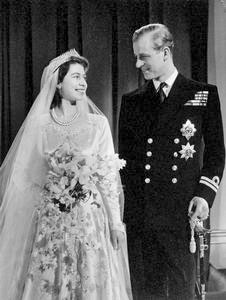
Elizabeth’s beloved husband came next.  Philip had to remove his coronet and leave it with Master Duncan Davidson on the scarlet cushion before mounting the dais to kneel before his wife.  He had scarcely seen her face since entering the Theater, but she had for him a very small, soft smile.  He who had held her hands through the ordeal of her father’s death, now placed his in hers and swore to be her “liege man of life and limb, and of earthly worship; and faith and truth I will bear unto you, to live and die, against all manner of folks.  So help me God.”

He stood and leant forward to touch her crown – and kiss her cheek – before walking backward down the steps to regain his own coronet.  One wonders what Philip might be able to teach us about the importance of making sure each marriage partner fulfills the ministry God has given.  He, who was in line for the throne of Greece had that monarchy survived, has certainly helped make sure Elizabeth fulfilled hers.

After Philip had paid homage to his new Queen, Elizabeth’s uncles came.  The Dukes of Gloucester and Kent, her father’s brothers, came and presented themselves before her.  This . . . is not easily understood.  The throne had not come to them; they came to bow before law, tradition, and sovereignty.

Then the Duke of Norfolk, and with each successive degree of lordship, the dukes came and repeated the words of oath and loyalty that were spoken at Elizabeth’s feet, until all that was noble in the land had vowed to defend and serve this young Monarch.  The very next in succession, however, the young Prince Charles in his immaculate white coronation suit, had grown fidgety and had been quietly removed from the royal balcony.

What would it be like to know that one was, shall we say, 17th in line for the same throne upon which Elizabeth sat?  Or 34th?  Or third?  All the peers of the realm have their order of descent.

We are, each and all of us, only once removed, and in the Lord our Savior, we are not removed at all.  We are seated at the right hand of God, enthroned in heavenly places in Christ Jesus our Lord, and He has come to take His seat on the throne of our hearts.

Since, then, you have been raised with Christ, set your hearts on things above, where Christ is, seated at the right hand of God.  Set your minds on things above, not on earthly things.  For you died, and your life is now hidden with Christ in God. (Colossians 3:1-3, NIV)

The momentous matter is before us . . . did we wake up this morning to reign and rule with our Lord Jesus Christ?  Will we, today, be about our Father’s business just as He was, paying unfailing homage to the finished work of Jesus Christ.

Elizabeth was known to say, “This is what my father would have done,” especially in the early days, and that was wisdom, for he was wise, and it kept her at peace while she found her footing.

Jesus is our footing, and the pathway for our feet.

Brian Barker has captured a moment in time for us in his splendid book.  When the Queen Was Crowned:

“As Baron Mowbray came slowly backward from the Homage, silence fell briefly on the Abbey.  The ceremony of the Coronation was over.  The Queen had been crowned as Alfred was crowned, anointed as Edgar had been anointed, had been sworn as the Lion Hearted had once been sworn and had received the Homage in the words and form in which the Lords of the Council had knelt to do their Homage to the first Queen Elizabeth.  I think that all of us there who looked towards the young Queen Elizabeth, crowned and golden, felt that something very important, very old and sacred, had been consummated in that place.”

         There was a day, a time, when something more ancient, something eternally sacred, something of consummation far more holy and secure, happened to us.  Let us this day and from this day, ascend to that throne where we have been made welcome.  Let us regain our crowns at the Lord’s feet and, in the paths we walk on earth, walk no more as mere men.  (1 Corinthians 3:3)  Amen.

Day Thirty – “Be Strong and of Good Courage”

Posted by Cor Unum Abbey on June 3, 2013
Posted in: Uncategorized. Tagged: Coronation, Elizabeth II, Inthronization. Leave a comment

Image

The bells in the north-west Abbey tower are pealing wildly, and ‘by signal given’ the mighty guns at the Tower begin to fire.  The millions of souls on the streets are cheering “God Save the Queen!  God Save the Queen.”  Archbishop Fisher has lifted the ancient crown very high; it seemed suspended in air for a moment, and then . . . it rests where it belongs, on the head of the Sovereign of the Realm, the fortieth from William the Conqueror, but at least the 63rd from the very first rulers of the British Isles.  She will never wear St. Edward’s Crown again, after this day.

When the tumult in the Abbey finally began to recede, the Archbishop spoke these words that had been spoken over those who had sat where she was sitting since 973 . . .

“God crown you with a crown of glory and righteousness, that having a right faith and manifold fruit of good works, you may obtain the crown of an everlasting kingdom by the gift of Him whose kingdom endureth forever.”

From the first entries in this little volume, we have been moving toward this day.  We spoke of traveling through life, crowned with lovingkindness and compassion, as Elizabeth wore the George IV diadem to her Coronation.  St. Edward’s crown, magnificent upon her royal head, is to us that other crown, the one which we are yet to wear.

Might not there have been a faithful little housewife, a humble coal miner or gardener or cobbler or bank treasurer who knew, as the moment came at last, that their moment would come some day, when they would have crowns of righteousness to lay at the feet of Jesus?  Without doubt, such thoughts must have filled the hearts of many, those who knew their Bibles, who knew that a royal heritage was not Elizabeth’s alone.

As the cheering went on in the streets, one jubilant crescendo after another, the choir inside the Abbey took up a ten century-old anthem, the “Confortaré” of King Edgar’s day of enthronement.

“Be strong and of good courage,” they sang.  “Keep the commandments of the Lord and walk in His ways.”

If ever she had been her own woman before, that life had come to an end for Elizabeth, but she willingly gave herself to the Recognition and the Anointing and the Investiture and the Crowning . . . not at all far removed our lives, rightly lived, for we are “bought with a price, and we are not our own. (1 Corinthians 6:19 and 20)

Now the Archbishop, in his full ecclesiastical splendor, pronounced the Benediction over Elizabeth and the Peoples of the Commonwealth during this reign.

An honor guard of peers of every degree was forming up the steps to the throne.

At earliest coronations, and according to the Liber Regalis, the Sovereign was to be enthroned at some height, where he would be visible to the people, and he was lifted, literally carried, to the throne.

Elizabeth rose from St. Edward’s chair, facing the congregation for the first time since the Recognition.  She looked so small and so strong and so delicate and so determined.  She mounted the five steps, and by simply reaching out to touch her as she turned (and to help her with the yards in length and pounds of weight of her robes,) they “set her” upon her throne.

“Stand firm and hold fast from henceforth the seat and state of royal and imperial dignity . . .” said the Archbishop.

“ ‘Watch, stand fast in the faith, be brave, be strong . . .’, and ‘Stand fast therefore in the liberty by which Christ has made us free . . .’, said the emissary of the Bishop and Guardian of our souls.

“Therefore, my beloved and longed-for brethren, my joy and my crown, so stand fast in the Lord, beloved.’”  (1 Cor. 16:13, Galatians 5:1, Philippians 4:1) 

Day after day we have seen that we have a rightful place . . . a necessary place . . . in the Kingdom of God, and thus in history.  This is what Elizabeth saw and believed on behalf of her nation, and although our history is lived out on a very small stage, it is still recorded in heavenly annals.

We are lifted up to take our place at the right hand of God. (Colossians 3:1, 2)  Should we fail to do so, families and churches and governments, and nations which are comprised of these, will fail.  Our reign will be lost and the Kingdom of God will not prosper in our sovereign care, for caring is sovereign, as Elizabeth knows so well.  These thirty-two days together are about the majesty of caring enough to make sure we live according to the royal law of love.  This will require diligence, effort, perseverance, planning, the willingness to be misunderstood, and sacrifice.

The Queen went out from Westminster Abbey to return to work the next morning, a grueling schedule, an unbending regime, a heavy burden of responsibility.  All the Regalia and all the Vestments were returned at close of day to the Tower of London, and the Queen returned to her desk, her “boxes,” delivered twice daily, every day, of official correspondence,  her meetings and briefings and public appearances.

We have seen Her Majesty, seated in splendor upon her Throne, but when the new day dawned, she was, as before, one of the hardest-working women on earth, now consecrated to every effort, every difficulty and decision, and yes, sacrifice.  She has made a point of making others feel that their work and service matters supremely.  Her life tells us: if we will do what we have been given to do with all our hearts, persevering in all trial and all affliction, if we will continue in peace and goodwill, trusting in God and doing what is right, we will not fail of the majesty of our calling.

She has not failed.  She has triumphed, and so shall we, for Christ is our life, and His love never fails.  We are crowned and robed with it, vested with faith and hope, possessing the Sword of the Spirit, which is the Word of God, and wearing the Lord’s signet … “I am my Beloved’s, and He is mine”  (Ephesians 6:17 and Song of Solomon 6:3)

This remains … we may take the seat of sovereign care, where we will bear the burdens of others and so fulfill the law of Christ (Galatians 6:2,) casting our own care upon Him Who cares for us (1Peter 5:6, 7.)  This is majesty . . . this is the wearing of the royal robes and the possession of the almighty scepter. (Psalm 125:3)  This is the day-to-day measure of a life that will one day be crowned on high.  (Revelation 2:10)

Tomorrow and the next day, we will see the last and vital parts of this ceremony.  Today, we are crowned in beauty, robed in splendor . . . even if all that others see is that we took time with them, that we maintained a happy hope, and that we found our joy in the life we live in our Savior, the Humble King of Kings and Lord of All.

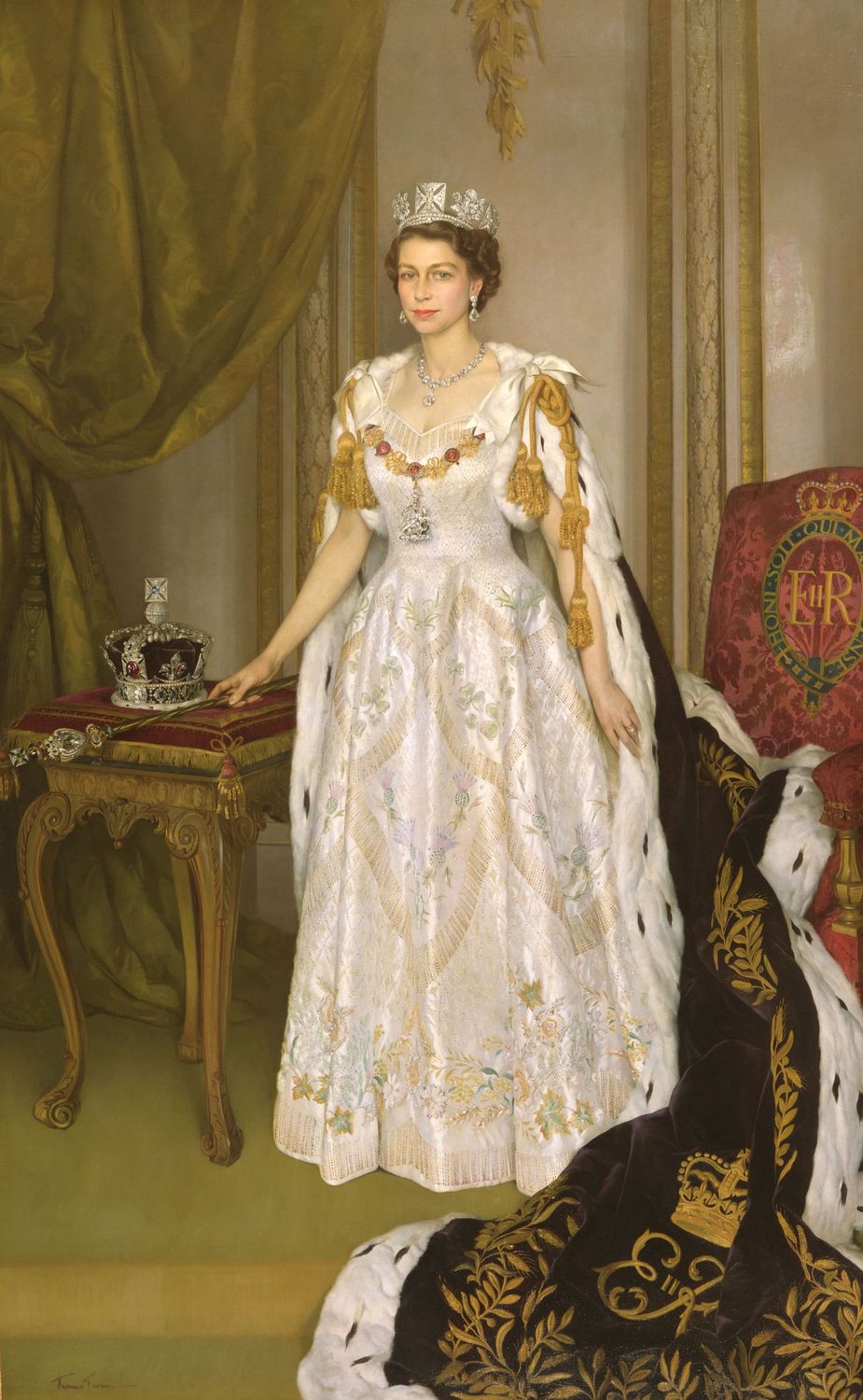
Portrait by,

Sir Terence Cuneo, 1953

Day Twenty-Nine – Privileged Sight

Posted by Cor Unum Abbey on June 2, 2013
Posted in: "Dieu et Mon Droit", devotional material, personal monasticism, Spiritual disciplines, The Coronation of Elizabeth II. Tagged: Coronation of Her Majesty Queen Elizabeth II. Leave a comment

RoyalRobe53a


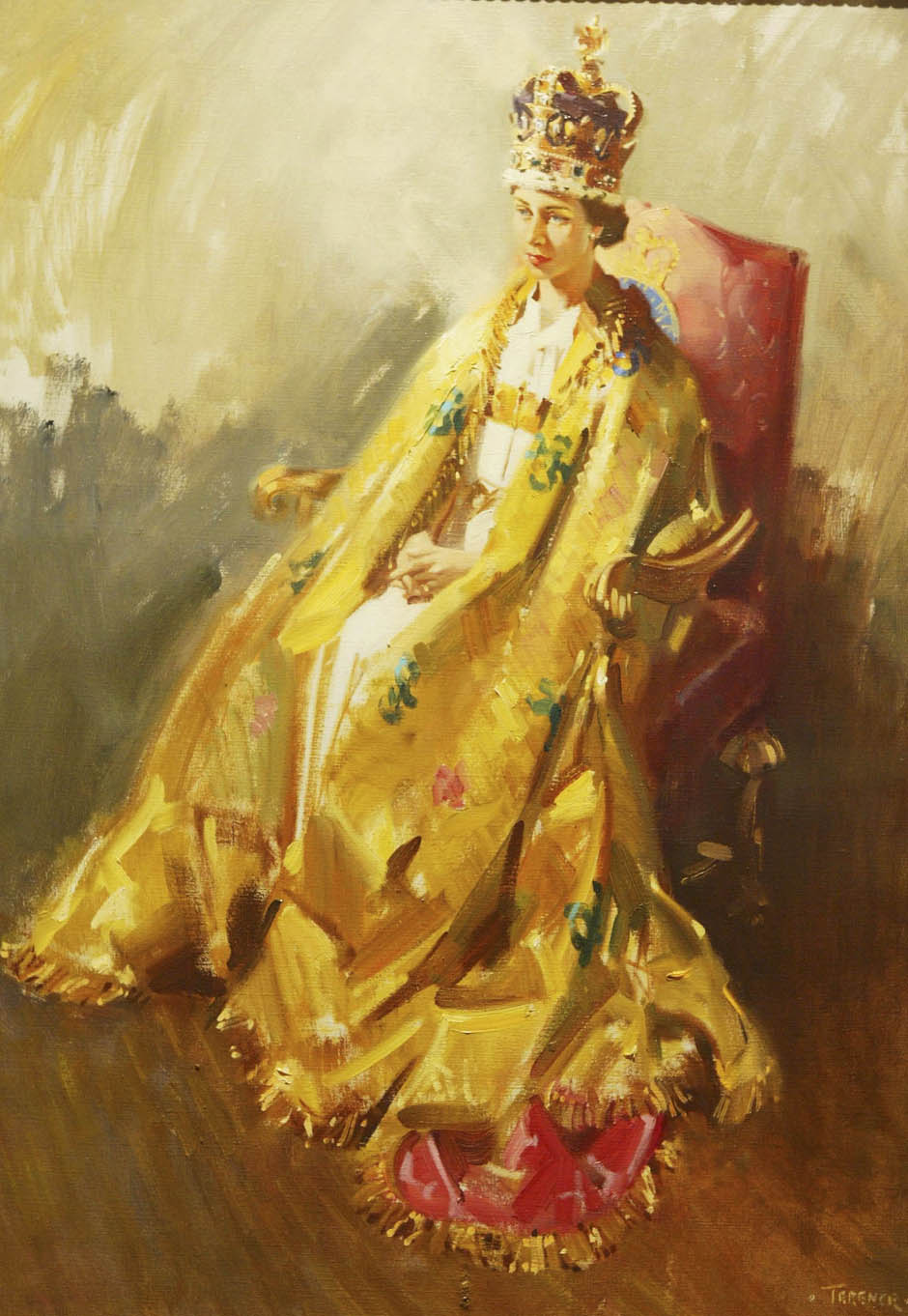
“The still figure in strange golden vestments seemed to have receded into a time far remote from our own.  She was like an image in a hieratic ikon, a page from an old richly illustrated manuscript . . .”  These are the words of Brian Barker, O.B.E., who stood among the very few alive on the earth who were able to see Her Majesty, Queen Elizabeth, as she sat, resplendent, in King Edward’s chair.

There were eight thousand royal and other invited guests in attendance, ringed about on the streets of London by three million more, but Elizabeth Alexandra Mary was alone before God and His representatives, receiving beautiful and priceless relics of coronation antiquity.  In fact, she was accepting something much, much more beautiful and without price.

Elizabeth was accepting responsibility before God.

Hers was to care for a nation, the answer to a calling that some say has become merely emblematic, yet her calling makes England . . . England!  Those who line the street to meet her when she steps out of her limousine will bow or curtsey to her, some wearing business suits and some in blue jeans.  When she smiles at them, they beam a happy, privileged response.  They did then; they do still.  She is a beautiful woman, particularly beautiful in her devotion to duty, because her people are her duty.

Brian Barker wrote . . . “The silence in the Abbey was intense.  The Queen was sitting stiffly upright in the old high-backed chair, a figure of shining gold with the jeweled Sceptres in her hands.  At that moment we saw her as no one would ever see her again in her lifetime.  She was remote from any familiar conception of royalty  . . .”

Precisely.  This was a moment in time that transcended earthly majesty, though it was replete with it.  Elizabeth was clothed in an actuality of consecration to God and duty toward man that none of us will ever experience, sartorially or ceremonially, but she was not gowned or vested with more salvation, more unction, greater anointing or responsibility than is ours for the calling with which we have been called.  We are vested with the promises of God, clothed in Jesus Christ and robed in righteousness.

As was true of Elizabeth in that moment, our splendor may not be seen by all, and seldom is our consecration put on view, but it is as real as was Her Majesty’s, and it is eternal.

In our Lord’s Majesty, and in His humility, we bear the glory of royal and eternal love and sacrifice.

*****

The Peers of the Realm, those with royal connections by birth and bequeathment, had brought their coronets to the Abbey, but they were not wearing them.  They had come in their scarlet robes, with rows of ermine (or rabbit if necessary) depicting their rank, but their coronets had been left in the care of their pursuivants.

These youngsters now entered the Theater, bearing the noble headgear.  Their colorful uniforms were a medieval splash in the gold and scarlet arena.  With a bow, they presented to the titled owners the symbols of their royal dignity and their subservience to The Crown.

The Archbishop was at the Altar.  He lifted St. Edward’s Crown high, and it responded with a flash of diamonds and rubies and emeralds . . . gemstones so large that it would take all the carats at a large jewelry store and more to equal their weight . . . and, setting it back upon the Altar, he blessed it.

“Bless we beseech thee this Crown, and so sanctify thy servant Elizabeth upon whose head this day thou dost place if for a sign of royal majesty, that she may be fitted by thine abundant grace with all princely virtues.”

         The Archbishop came down from the Altar, and the Ministers of the Church came with him.  The Dean of Westminster was bearing the Crown on a scarlet cushion, two tiny gold stars indicating the front to guard against the backward placement that had occurred at Her Majesty’s father’s Coronation.  All those given on earth to represent heaven’s glories now approached where the young woman sat, seventeen months Queen, now to be crowned and enthroned.

They stood before St. Edward’s chair where Elizabeth sat motionless.  The Archbishop lifted the Crown again, very high, the sleeves of his robes falling back; no one breathed.  Then it was done.  The Crown descended and rested on Her Majesty’s head.  A wave of motion swept over the sections of the peerage as they placed their own coronets upon their heads, noble because she is royal.  The cry rang out, “God Save the Queen!  God Save the Queen!  God Save the Queen!”

We pray that Elizabeth may, in the purity of heart and purpose that God gives, that He had in mind when He saw her, sitting alone and unobserved, obtain His secure blessings for the throne and nation of England and its Commonwealth partner nations.  As God saw her heart on that day, as He sees her even now, and as He sees all those whose hope is in Him, may He openly reward us with a revival in our hearts and in our leadership, in our homes and in our governments in this hour.

No potentate on earth is clothed in more splendor or vested with greater privilege than we, and none hold more power and authority than do those who obey the voice of God and walk with Him, in the fellowship of His Spirit.

Amen.

photo: Rotherham Web

Day Twenty-Eight – Two Scepters, One Glove, Mercy Triumphant

Posted by Cor Unum Abbey on June 1, 2013
Posted in: Uncategorized. Leave a comment

Image

In a moment, Queen Elizabeth will be holding both the Royal Sceptre and the Rod of Mercy and Equity in her grasp.  She will be fixed and transfixed by the power she holds in her hands, the power to bless and protect.  Others are brilliantly clothed, others wear robes and mantles and sparkling jewels, and in the moment when St. Edward’s crown in placed upon Her Majesty’s head, the peers may don their coronets, but only the Queen will sit enthroned with double-fisted authority.

Today, all that authority is vested by the people and worked out in Parliament.  Yet, by the people’s choice, warrants and medals are issued in her name.  Warriors fight and postal workers deliver the mail in her name.  They choose to honor and respect Her Majesty’s majesty.  Very little of what she does, very little, comes of her own volition, but everything she does issues from theirs.  She has much less power than an American President, though he may wish he had nearly as much influence.

Before the Rod and Sceptre are delivered from the Altar, as has been done from antiquity, she receives a Glove.  Lord Woolton, one of the newest peers at that time, came and knelt before Elizabeth and presented to her a glove for her right hand, the symbol of the abolished Danegeld.  This glove reminds her, even in such a glorious moment, superlative beyond measure, to have a gentle hand in taxation.  In this ceremony within the Ceremony, barons of old had kept their place in the Coronation in perpetuity, reminding the Monarch that without their supervision, their management of lands and lakes and laborers, there would be no England over which to rule.

No British monarch can set or establish taxation in this day, but once again, at the Coronation, Majesty represents fealty to the people.  Elizabeth and her family have further taken only very paltry cost-of-living style honorariums from the government, considering the expenses of their travel, entertainment, staff, and such matters, and the Windsors have themselves submitted to taxation.

Sometimes, in the places where we reign, be it over pre-school children or five-star financial conglomerates, sometimes what we DO NOT ASK of others will tell our tale.

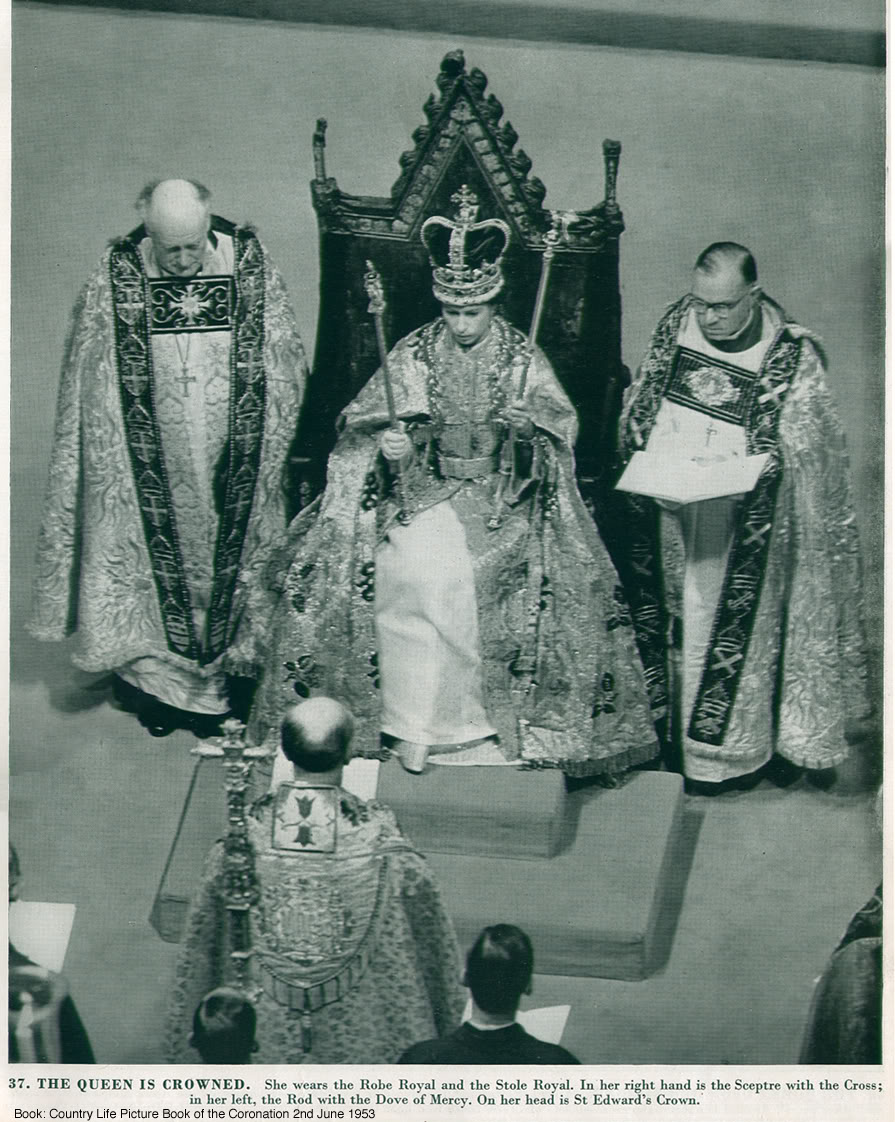
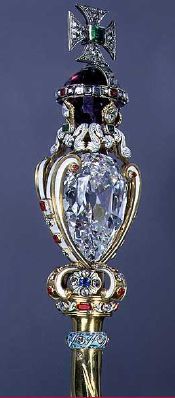
The Royal Scepter, the Scepter With the Cross, was presented to Elizabeth simultaneously with the Scepter of Mercy.  The first is ornamented with the Cullinan Diamond, Cullinan I, the Great Star of Africa, the second largest diamond in the world.  It was a potent illustration that she was given to reign in the steadfastness of “Kingly power and justice.”  The Rod with the Dove, bespoke the powerful injunction that justice was to be so executed that she would never forget equity and mercy.  “Be so merciful that you be not too remiss; so execute justice that you forget not mercy  Punish the wicked protect and cherish the just, and lead your people in the way wherein they should go.”

Elizabeth was still seated in King Edward’s Chair, facing the altar, not the audience.  Not yet enthroned, she was in her rightful, royal place in the high-backed chair where centuries of Monarchs, her relatives of old and of late, had been seated.  At that point in the ceremony, even her husband, Duke of Edinburgh, could not see her face.

The Swords and the Sceptres, the Orb and Armills, the Spurs and the Ring and the Glove had come to her one by one from the Altar of God.  Her head was still bare; she was wearing emblazoned gold on top of silk on top of linen over beaded and embroidered splendor, but very few saw the calm, resolute, certain, ready, God-fearing humility that those nearest her believed to have been apparent.

Strength and resolve adorned her more majestically than her robes and regalia. She would fulfill her destiny by the grace and in the reverential fear of the Lord.  Clothed in majesty, seated in glorious purpose, having every right to be where she had been chosen to be, she was no usurper.

All that took place that day, and the essential purpose of this volume, was the extremely evocative representation on earth of heavenly majesty, and that majesty ever and always under God and under Him alone.  Hear these words, then, today, and tomorrow we will see her crowned . . . we are

“Elect according to the foreknowledge of God the Father, through sanctification of the Spirit, unto obedience and sprinkling of the blood of Jesus Christ; grace unto you, and peace, be multiplied.

“Blessed be the God and Father of our Lord Jesus Christ, which according to his abundant mercy hath begotten us again into a lively hope by the resurrection of Jesus Christ from the dead, to an inheritance incorruptible, and undefiled, and that fadeth not away, reserved in heaven for you, who are kept by the power of God through faith unto salvation ready to be revealed in the last time.  (1 Peter 1:2-5)

We, at the right hand of God in Christ Jesus, are not usurpers, either.


The Scepter With the Cross, Wikipedia

Posts navigation

← Older Entries
Newer Entries →
  • Recent Posts

    • A Sea Change
    • La Alcaldesa
    • But, How?
    • In at the Deep End
    • December 5 – “Savior”
  • Recent Comments

    safelake's avatarsafelake on April 28 – “. . . With Y…
    safelake's avatarsafelake on March 6 – D. T. M. (Divine Tim…
    Cor Unum Abbey's avatarCor Unum Abbey on February 26 – What Nuns B…
    di french's avatardi french on February 26 – What Nuns B…
    Cor Unum Abbey's avatarCor Unum Abbey on February 26 – What Nuns B…
  • Archives

    • August 2024
    • February 2024
    • December 2018
    • January 2017
    • March 2016
    • November 2015
    • September 2015
    • April 2015
    • March 2015
    • February 2015
    • January 2015
    • November 2014
    • October 2014
    • September 2014
    • August 2014
    • July 2014
    • June 2014
    • May 2014
    • April 2014
    • March 2014
    • February 2014
    • January 2014
    • June 2013
    • May 2013
  • Categories

    • "Dieu et Mon Droit"
    • 40 Days of Prayer for America
    • devotional life
    • devotional material
    • monasticism
    • personal monasticism
    • Prayer for the oppressed
    • purpose in life
    • Spiritual disciplines
    • Spiritual warfare, Prayer for loved ones, Prayer for the nation
    • Thanksgiving
    • The Coronation of Elizabeth II
    • Uncategorized
  • Upcoming Events

  • Meta

    • Create account
    • Log in
    • Entries feed
    • Comments feed
    • WordPress.com
Blog at WordPress.com.
Cor Unum Abbey
Blog at WordPress.com.
  • Subscribe Subscribed
    • Cor Unum Abbey
    • Already have a WordPress.com account? Log in now.
    • Cor Unum Abbey
    • Subscribe Subscribed
    • Sign up
    • Log in
    • Report this content
    • View site in Reader
    • Manage subscriptions
    • Collapse this bar
 

Loading Comments...