
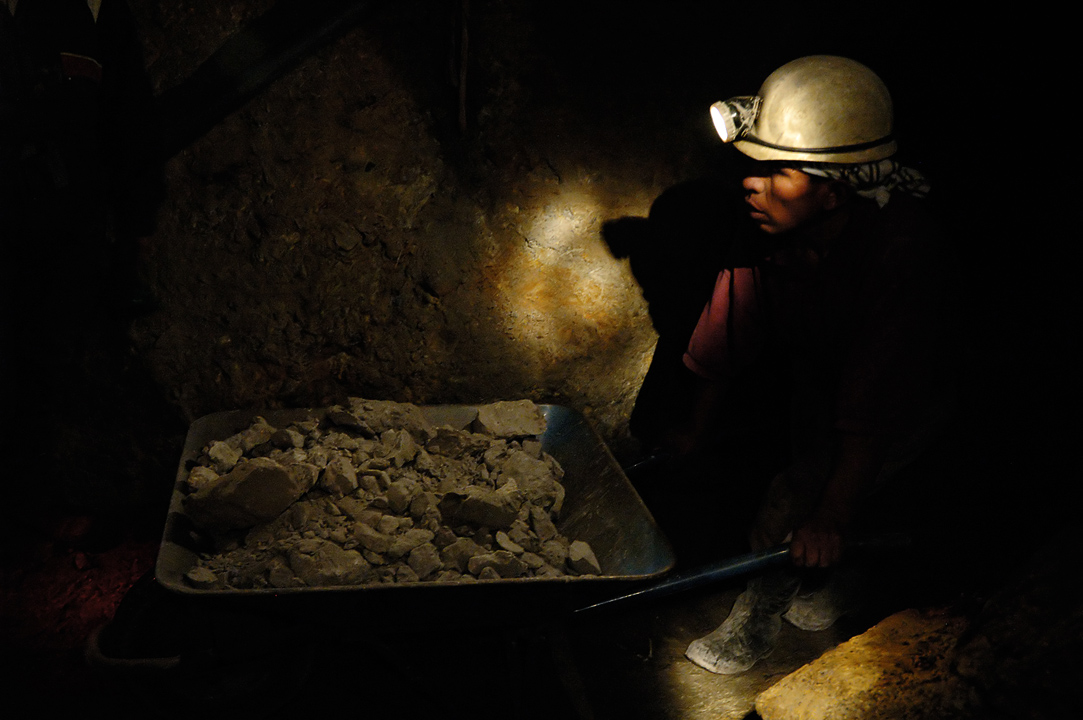
Miner in a Gallery in Potosi, Christophe Meneboeof, Wikipedia, by permission
When the change began, it was bolstered by human nature. It was almost like the principle of physics, an object at rest tends to remain at rest … but once they were doing something up above, the mechanics and drills, the geologists and mining officials, politicians and journalists, all became feverishly involved. Three essential plans were drawn up, combining in the abstract to give the best chance of breaking through at the presumed location, the refuge, “El Refugio.”
In the mine, half a mile down, there was another kind of sea change. The men had now been more than two weeks with no more food than their daily teaspoon of tuna fish and their half a cookie. In the first hours, several men had, in opposition to an instruction, broken into the small food locker and devoured many bags of cookies and all of the canned milk that was there and fresh. Now, they had had weeks to consider how far that food would have gone, added to their very meager store of sustenance.
Now, they all, still having heard no sound of drilling, having had time to consider how impossible was their situation, having had time to consider their fate in the light of their faith or the lack of it, they were moving beyond misery and into a quiet despair. Day after day, always darker than night, except for the feeble and fading headlamps, which they used as sparingly as possible, they sat, they wondered; they hoped, but their hopes were growing more feeble than their headlamps.
One bulb hung over the refuge, wired to a truck battery by one of the men in the early days. Its light was eerie and they all looked as though they were not just underground, but underwater. The psychological pain of helplessness was pervasive, in the brighter light of their situation and of their mortality.
There were physical anomalies now; most had digestive problems and terrible constipation, and others were breaking out in rashes from the dirt and heat. Sleep was a blessing, but it was always troubled and not refreshing. From time to time, someone would attempt to shore up the others, point out that it would have to be many days before they could hear any drilling through that much rock. They tried to assure one another that their families would not give up on them, but they knew that the hearts of the mining officials were as hard as stone, sometimes. Witness the utter lack of adequate supplies and, above all, the utter neglect of the chimneys meant to provide a means of escape.
They thought how surely their families must be starting, at least by now, to see them as dead or dying, even if they had hoped they might have survived the collapse.
For our purposes, let us consider our “33” and as we do, are there not names that stand out as those who are, and long have been, pretty sure that no one is really looking for them? In their loneliness – darkness – despair, there are surely those who could not imagine anyone caring enough for them to keep up a barrage of prayer and worship, hope and faith. Are there not those who feel certain that, in their “captivity,” they have entombed themselves because of their sin, their own unkindness, their own lusts or doubts or denial of both God and friendship? When they look out of the window of their souls, they see immovable slabs of unbelief, and in truth, no one comes to faith on his or her own merit any more than those miners could move that mega block. Some of our own 33 feel like nobody is looking for them or cares where they are, and that God could never reach them and, they think, clearly He would never care to lift them up from the depths.
They are already proven wrong. We do care, and we are praying the heart of God for them.




 Cor Unum Abbey