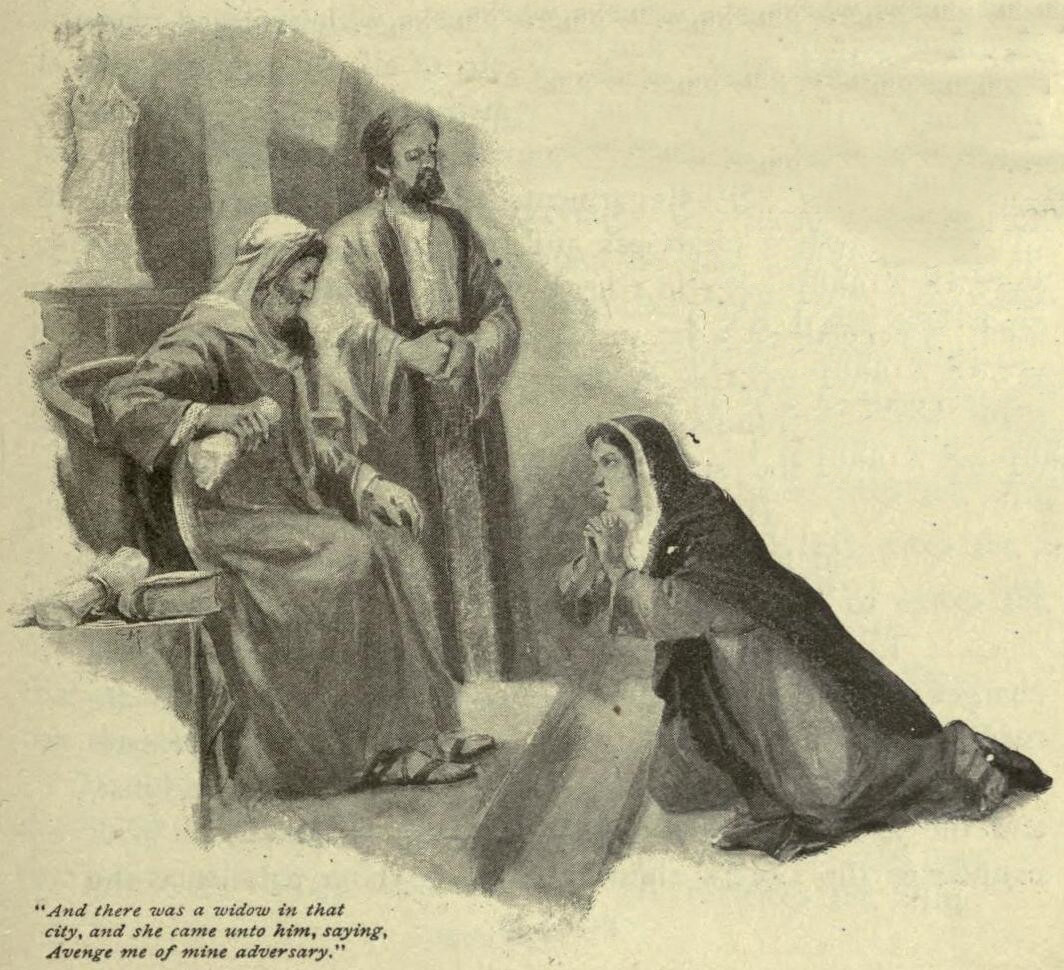
“And there was a widow in that city …” anonymous artist, 1900, “Christ’s Object Lessons,” by permission, public domain, death of the artist, Wikipedia
Things were moving almost as slowly on the surface as they were in the mine.
Families were beginning to gather as the first days slipped into a week. Some organizations were arriving to provide tents and blankets and provisions for the waiting and expectant families, but nothing was happening.
Men with hard hats were still milling around, with very worried or sadly hopeless looks on their faces. Who could blame them? There was nothing they could do! They didn’t know with certainty where the men were, whether or not they were alive, and no one had any hope of reaching them if they were down where they were supposed to have been working that day. They knew that if they began drilling, at best they would not reach the refuge area for four months. At best, with no equipment issues and no failed attempts. They also knew that they had food, at best, to lastfor days, not weeks or months.
Relatives were tired, frightened, and now trapped behind a makeshift fence. They hollered and made noise on the fence wires, and sometimes one or another of the supervisors came to talk to them, but that only increased their fear.
Laurence Golborne, a mining engineer and an educated man, acted as liaison between the families and the other engineers and volunteers, but day after day there was absolutely nothing to report, and day after day the family members vested their feeble hope in his authority.
One woman, not a wife or a sweetheart or a mother, but the sister of one of the miners, would be not quieted. She wouldn’t hold her peace and she wouldn’t let the others to so, either. She, of all those gathered, was the “do something!” voice. The danger was very real that after a respectable number of days the stone would be rolled in front of the entrance, a cross set up, and everyone sent home to mourn. She wouldn’t have it. Not until they tried.
She would not be quieted until they tried something, until they began to drill, until they put some plan in motion. Before long, everyone was calling her “La Alcaldesa,” the mayoress, and indeed, she became representative, spokesperson, and de facto leader of the family congregation. She said, “They could be alive, and they are counting on us!” Her name was Maria Segovia, and she had been taking care of her little brother Dario all his life. She wasn’t going to stop now.
Once, in Scripture, another woman alone, a widow, took her case to a judge so unjust that he boasted that he feared neither God nor man, but that widow, coming day after day, pleading her case, was rewarded with his attention, not because he cared, but because she would not STOP! And Jesus uses this very example to teach us, as He Himself said, to pray and not give up. What cause is more just than that of people we know who, many of them, don’t even know how they got where they are, or if they do know, have no idea how to reclaim their lives? The Lord God sees the injustice of the play of devilish fears upon unprotected children, wounded wives (and husbands,) teen-agers that no one has been able to reach. Any of these might be trapped, down, down, deep down, in a place darker than most of us have ever known.
How clearly Jesus says, “If that unjust judge is moveable, how much more willing is Your father Who loves both you and those for whom you pray?”
Look at the unjust judge whom Jesus so clearly represents to us! Look at Your Father, Who gives you the kingdom! Why, I’ve wondered many times, why does He, the Father, sometimes seem to wait for us, to wait until our love and compassion catch up to His? All that we want Him to do, He could do in an instant, without our prayers. He could, but when He incorporated us into His kingdom and into His Son, He no longer would. Our prayers are His heart and His promises, uttered on the earth. He waits to hear them.
I’ve wondered, perhaps you have, too, but our questions REGARDING prayer are not as important as the undeniable ache in our hearts for those who go about “oppressed, downtrodden, in chains not broken.” This we do know, the honor of standing where Jesus stands in respect of those persons, to share His grief on their behalf even for thirty seconds, is something holy and not manufactured. What could be done without us – we ought to rejoice! – will be done with us and through our prayers and our faith. Because both, our prayers and our faith, are ours in Christ Jesus!
Do our prayers seem weak? Does our faith seem small? We invest the talent we’ve been given, and we can always care deeply. Nothing expands compassion like prayer when we cry out for those wounded and oppressed!
There was never any doubt among those who waited and those who watched that without the intervention of Maria Segovia, the Miracle of Mine would have become the Catastrophe of the Atacama Desert. We asked before, “But how?” and certainly one of the overarching answers is … by our persistence.
Are not some of our 33 just as lost, just as buried in darkness, just as cut off? … but not from our care and our faith.


 Cor Unum Abbey