
We will come back to Sister Thèrése from time to time in Cor Unum. She has much to teach us. She was a nun because she was Catholic and because the monastic way of life was highly prized in her family and because her sisters were nuns . . . but more than these, she was a nun because the love of God was the calling to which she dedicated her life. Thèrése is a nun we have come to know, whose little journal entries have come down to us, because she gave herself to the yoke of the Lord Jesus Christ, the yoke of His love.
She was not always a monastic celebrity. One of her sister nuns at the Lisieux Carmel made the observation that she could not see what all the fuss was about Thèrése. By the time of her death her “Little Way,” which bespoke a way of hard choices, humility, misunderstood motives, and loneliness for love’s sake, had begun to glisten and gleam a light of truth into the monastery. The goal of her life was to turn every opportunity to love into real love. The flame had not caught in every lamp, but when love is the genuine article, it cannot be concealed for long.
We can only imagine that Thèrése might have laughed at the Sister’s observation and said she didn’t understand the fuss either, that the way of love which demonstrates the way God has loved us is only the most sensible and normal pattern of life to be found.
It is said that Confucius had his own version of the Golden Rule: Do not do to others what you would not have them do to you. The difference between his words and the words of Jesus Christ are the difference between being yoked to love and yoked to fatality and isolationism. We in Cor Unum will choose love, with all its tendency to ruin our plans and humble our stature and leave us standing all by ourselves.
Then we will look around and remember that in Cor Unum, we are in the best of company!
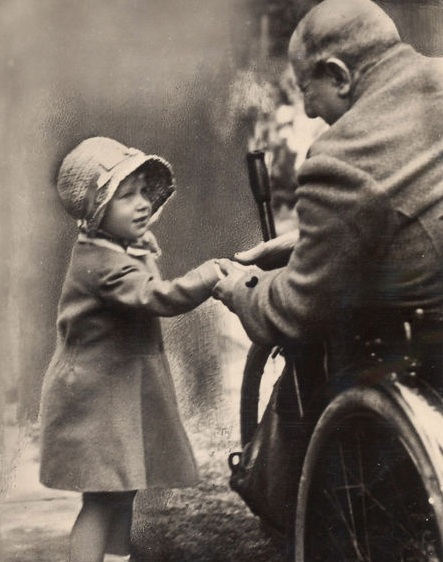
Princess Elizabeth
with World War II Veteran, public domain


 Cor Unum Abbey