“Lectio Divina” is the Latin term for “divine reading.” There is nothing more divine in our study of the Word of God than to encounter Him there and then to walk with Him in faith after we close our Bibles and go on with our day.
This is the purpose of “Lectio.” Its practice is making a big comeback in many circles as lay men and women have begun to discover the effectiveness of the prayerful, expressive, listening, worshipful, humble application of the Word of God.
Prayerful. Expressive. Listening. Worshipful. Humble. All of these are relationships we would like to say we have cultivated toward God. In “Lectio,” we shall.
Today, let’s look at that powerful, miraculous passage in Hebrews 4:12. First, as we open our Bibles, we pray, asking God to show us what we may see there, to show us what we could never see without Him. What an enormous difference it makes when we humble ourselves always, in all things, to pray first! Now we read in the Presence of the Lord. We make note of what we see, of the questions that arise, of the things that are evident, of the revelation of the character of God. We can read again and again until we feel we have begun to hear these words as from the Lord Himself. This is the training we have undertaken in Cor Unum, one of the slow and steady conversions that we know will bear fruit in our lives. We will always read larger segments of Scripture, reading through the Word of God year by year, but we will take time to pause and consider and be changed as we go.
Now we read again and make a list of as many elements as we can draw from the text.
Here is an example, from Hebrews 4:12 . . .
• the Word of God is alive
• it is active, it DOES something
• it is sharp, it cuts . . . sharper than a sword that cuts both ways
• hmm . . . wonder what that signifies? (It is honest to ask questions, without doubting)
• it pierces so deep as to divide our souls and spirits
• (like dividing?) joints and marrow … apparently our souls and spirits are not one and the same
• the Word of God judges the thoughts of the heart … does my heart think on its own?
• it judges the intents of the heart … that would be a valuable assessment
Those are the items that are clearly stated, even if we don’t completely understand them. In Cor Unum, we cannot read over the Word of God to get to the next point, the tag line, the “zinger,” or the end of our assigned reading! After we see the literal, factual elements, we can begin to apply them, prayerfully, and we do well if we take time to let the living, active Word act upon us at some point whenever we read.
We can pray for ourselves and others as we travel through the Scripture. “Lord, Your Word can live in me and in those I love; it can change anything and everything. You can show us what we’re really like, and Your Word can form in us the strength and faith and love that makes people new and free. Judge my thoughts, Lord; judge my heart. I’m not afraid of Your judgement … You gave Your Son so that we don’t even have to fear our own sinfulness and our failures. We are safe with you, and when your sword cuts, it heals, I know.”
As Professor Agassiz’ students learned to look, to keep looking, and to SEE their fish, we will begin to see God in ways we never dreamed He could be known. We will see the Son of God, obedient to the Father, full of compassion, powerful in meekness, conqueror, not victim. We will be able to see our hearts as His home; that He lives in heaven and He lives in us. Cor Unum Abbey will become to us a place of sweetest delights and liberating truth, because here we dwell in the Presence of God, and here he dwells in us. Just the time we take, just reading and praying, looking and listening, is healing and strengthening.
“Look, look, look! Look at Jesus, the Word made flesh! Look at the Lord of life! Look, look!”
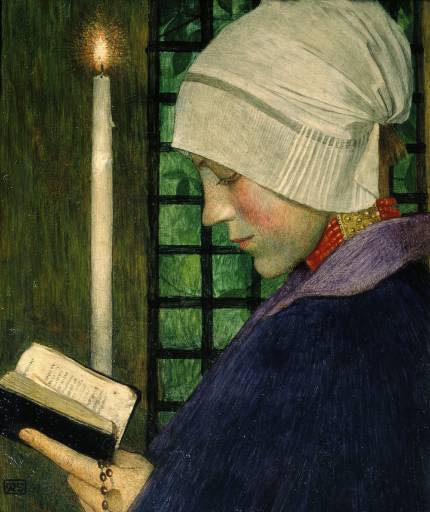
“Candlemas Day”
Marianne Stokes, by permission


 Cor Unum Abbey