
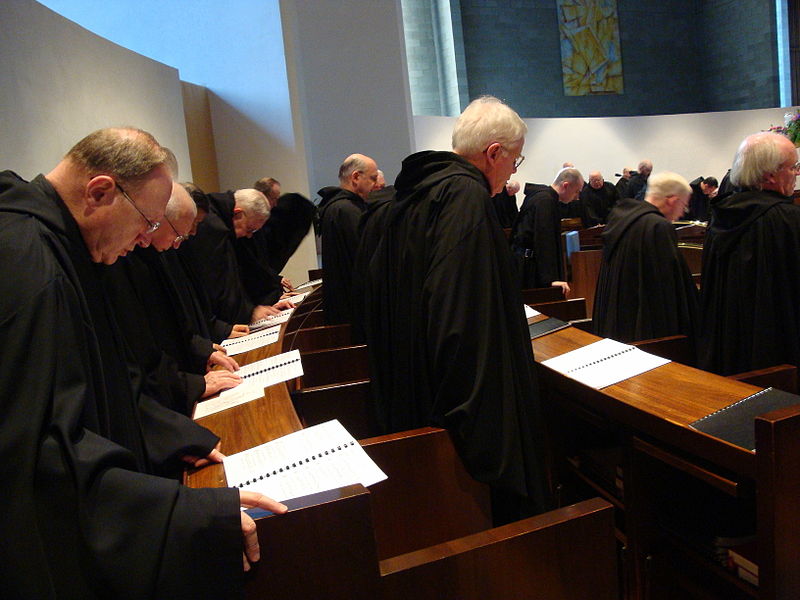
While passing through entrance interviews, the candidate for postulancy will become well acquainted with the rudiments of the Benedictine vows.
Benedictines do not take the more familiar vows of chastity and poverty. The postulants and novices move toward final vows of 1) obedience, 2) stability, and 3) “conversatio.” These have a spiritual genius about them. Let’s see what we can learn that will work for us here in Cor Unum Abbey.
The Benedictine considers that the Abbot or Abbess having charge and care of the house is God’s agent to love and watch over all and each, and to see the house remain, hopefully to the end of time. To the Benedictine, it is nonsensical to strive for excellence of spirit and refuse to obey those whose purpose in life is to see that you get there. The Benedictine superior is as given to obedience as those who obey, for the Abbott or Abbess has the most demanding vocation of all. The souls in their care have come into the monastery to be inexorably moved along toward the love of God and transformation into the image of His Son. A prideful, petty, or persnickety Abbess would not suit, for faith alone can set out upon such a quest, and faith works through love. Those who, by their vote, have chosen her know that they will have to obey her for the duration of her life, or theirs. They choose wisely in the election of each new Superior.
We are the Abbots and Abbesses of our own souls here, under the watch care of the Holy Spirit. We needn’t be prideful in all we demand of ourselves, or petty or persnickety, either. As we pray for ourselves and others, in wisdom we know that the Lord wants to get us where we want to go, and He will undertake that we shall arrive.
Stability is a vow largely unique to the Benedictines. Monks and nuns will vow steadfast devotion to the very house which has welcomed them. They are the homebodies of the orders, the contemplatives.
The third vow is that of conversatio. This is a Latin term from the phrase “conversatio morum suorum,” indicating that the Benedictine vows to keep changing in pursuit of the likeness of Christ. A vow to keep changing. Goodness gracious!
Isn’t it interesting to note that the vow of chastity becomes redundant? If a Benedictine stays with the order (stability,) and submits to the obedience of Scripture and Benedict’s rule for monastic life (obedience,) chastity is a “given;” it is required within the house. Benedictines do not vow to keep poverty, because within the enclosure all are rich or poor together. Usually not rich! Benedict settled these matters, and those who enter are under obedience to his rule. All that comes in is spent on the welfare of the house and the needy beyond its walls. Thus, no separate vow of poverty is taken, and none is necessary.
Observing chastity and poverty within the vows of stability and obedience, the Benedictine has opportunity to take up the more searching vow, the more crushing vow, in the sense of crushing thyme and rosemary to release their aroma. The Benedictine vows to keep changing in pursuit of the likeness of Jesus Christ.
Let’s consider today, what walls keep us safe from leaving our first love? What allegiances help us to continue to transform into the image of Christ? Where we must obey, let it be for His sake. Here together in Cor Unum, we will never settle for “good enough” when the prize is the likeness of Jesus, the Son of God. (2 Corinthians 3:18)
2 Corinthians 3:18 … And we all, who with unveiled faces contemplate the Lord’s glory, are being transformed into his image with ever-increasing glory, which comes from the Lord, who is the Spirit. (NIV)
Benedictine monks at Vespers
by permission, John Stephen Dwyer (Boston)


 Cor Unum Abbey